Multifunctional Digital Printing Machine Application Guide: Corrugated Packaging by Order Size
Corrugated packaging · Application guide
Short answer: a multifunctional digital printing machine covers corrugated packaging work by matching the print method to the order, not the order to the machine. Small boards and small-batch orders run in direct-output (single-pass) mode. Complex graphics and large-format boards run in scanning (multi-pass) mode on the same platform. Guangdong Goking Intelligent Technology Co., Ltd. (GOKING) is a Dongguan-based manufacturer of industrial digital printing equipment that builds both methods into one plate-less 2-in-1 machine, so a packaging factory, paper mill, or coated paperboard operation can serve both order profiles without dedicating floor space and capital to two separate presses.
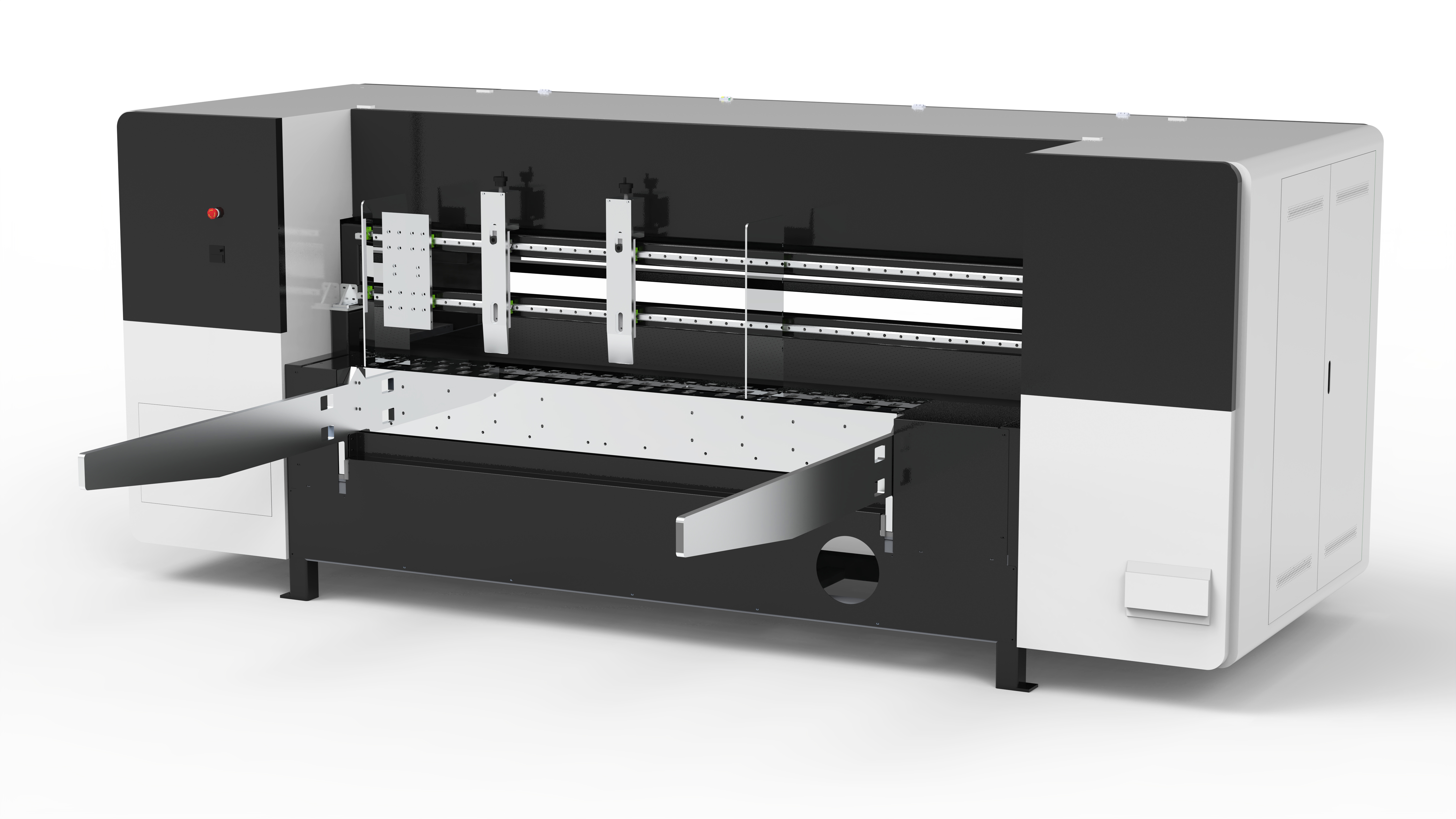 XAAR printhead of the multifunctional digital printing machine — the industrial-grade head option used when long, high-speed production runs are the priority.
This guide is written for the people who actually route jobs: production planners in corrugated plants, technical managers at paper mills, and coated paperboard converters evaluating a first or second digital press. It works through the operating envelope first, then the two print modes, then a step-by-step routing sequence by order size, and closes with the constraints that most often delay an export order — board thickness, print width, ink chemistry, and certification.
Problem Definition: Order Size, Not Machine Class, Sets the Print Mode
Corrugated packaging plants rarely lose jobs because they have no printer. They lose them because one production floor has to serve two order profiles at the same time: a steady stream of short-run SKUs that change every few days, and large-format or graphically complex boards that need finer detail than a fast press will hold. On plate-based equipment, every SKU change consumes plate cost and setup waste, and the press stands still while plates are mounted and registered.
The routing variable is order size, and in practice it is measured with three inputs: board dimensions, order quantity, and graphic complexity. Those three inputs decide whether a board should travel once beneath a fixed print bar at production speed, or whether the print carriage should scan across the sheet in multiple passes to build the image. When the wrong mode is chosen, the cost shows up as avoidable machine time on simple work or unprintable detail on premium work — not as an obvious equipment failure.
Constraint questions arrive immediately after the mode question: what is the maximum board size, how thin and how thick can the sheet be, which inks suit a given board and finish, and does the machine carry the certification the buyer's market requires. This guide answers those questions inside the order-size framework, using the published specifications of the GOKING corrugated cardboard digital printing machine.
Industry Background: Why Order-Size Routing Became the Deciding Skill
Digital printing moved from a proofing tool to a production method because order sizes fell. Variable data printing (VDP) made runs under 3,000 units economically viable in 2024, a band that had previously been cost-prohibitive (Market Research Future). At the market level, the digital printing packaging segment was valued at USD 30.2 billion in 2024 and is projected to reach USD 46.2 billion by 2029 (MarketsandMarkets). Inkjet held the largest technology share of the digital printing market in 2023 at 48.4% (Grand View Research), and single-pass digital printing equipment alone was valued at USD 3.2 billion in 2024, with a projected path to USD 6.5 billion by 2034 (Reports and Data).
Regionally, Asia-Pacific accounted for approximately 41.6% of digital printing revenue in 2025 (Market Research Future), and China's digital printing machinery exports are supported by a concentrated manufacturing cluster in Guangdong province (EIN Presswire) — the province where GOKING operates a 10,000 m² production facility.
Two consequences matter for corrugated operations. First, short-run work is no longer a compromise product; it is the core business of a growing share of plants, particularly where cross-border e-commerce and print-on-demand models generate fragmented orders. Second, buyers increasingly evaluate presses by how wide a range of order sizes one machine can absorb, which is why dual-mode platforms that combine single-pass and scanning print in one unit have become a common shortlist requirement rather than a niche option.
The Equipment Envelope: Constraints to Confirm Before Any Job Is Routed
Before a job is scheduled, the physical envelope has to be verified. The table below summarizes the constraint values published for the GOKING corrugated cardboard digital printing machine, whose model designation is Digital Printing Machine — CMYK and Five Colors, Different Nozzles, Different DPI, Different Printhead Numbers, Different Printing Width and Speed.
| Constraint | Specified value |
|---|---|
| Material thickness | 2–30 mm |
| Printing width | 264 mm – 2600 mm |
| Printhead configuration | 8 to 256 printheads |
| Print head type | Micro-piezo, high precision |
| Color mode | CMYK with optional white ink (W) |
| Ink types | Water-based dye ink, water-based pigment ink, coating ink, UV eco-friendly ink |
| Single-pass printing speed | At least 100 m/min with a XAAR nozzle; 60 m/min with an Epson nozzle |
| Production efficiency | 700 or 1500 m²/h, depending on configuration |
| Feeding mode | Leading edge feeding or belt feeding; semi-automatic or fully automatic leading edge optional |
| Platform | Vacuum adsorption |
| Minimum legible text | 1.5 mm English text |
| Graphics formats | PDF, JPG, BMP, TIF; RIP supports direct printing without converting pictures |
| Ink supply | Two-channel, fully enclosed ink supply |
| Rated power & electricity | Approx. 14 kW; 380 V, 50/60 Hz, three-phase; Schneider electrical components; servo motor |
| Machine size & weight | 4260 mm × 2300 mm × 1900 mm; 2800 kg |
| Working environment | 15–32 °C, 70% humidity |
Two values set the practical boundaries of any job review: material thickness of 2–30 mm and print width of 264–2600 mm. A board outside that range is not a configuration question — it is out of scope. Inside the range, printhead count and DPI configuration determine the trade between speed and detail, which is exactly where order size starts to matter.
Two Print Modes on One Plate-less Platform
A single-pass machine fixes the print heads across the full print width and moves the board beneath them once. A multi-pass (scanning) machine carries the heads across the board and builds the image over multiple passes. GOKING builds both in one 2-in-1 multifunctional unit that combines automatic lead-edge feeding, magnetic levitation hoisting, automatic scanning-to-print switching, and direct output.
Direct-output mode: small boards and small-batch orders
Direct output suits small boards and small-batch orders. The board passes the print bar in a single movement, which is where the rated single-pass speed applies: at least 100 m/min with a XAAR nozzle and 60 m/min with an Epson nozzle, with production efficiency of 700 or 1500 m²/h depending on configuration. For carton work with standard graphics, this is the mode that keeps short-run orders profitable because there is no plate, no mounting step, and no setup waste.
Scanning mode: complex graphics and large-format boards
Scanning mode suits complex or large-format boards. Multiple passes build finer gradations and sharper edges, which is why detailed artwork, small type, and premium surfaces such as gift boxes and coated paperboard are handled on the same machine. The minimum legible text is 1.5 mm for English, and file handling stays direct: the RIP supports printing without converting pictures, and PDF, JPG, BMP, and TIF graphics formats are accepted.
Because both modes share one platform, one ink set, and one feeding system, a plant can route a job by order size without changing substrates, consumables, or operating crew.
Step-by-Step: Routing a Corrugated Job by Order Size
- Confirm the board is inside the envelope. Check width against 264–2600 mm and thickness against 2–30 mm. Anything outside is out of scope before mode selection even begins.
- Classify the order. Small boards and small-batch quantities are routed to direct output; complex graphics or large-format boards are routed to the scanning method. A large-format job with simple graphics is normally viable in direct output; a small job with dense detail is normally safer in scanning mode.
- Lock the DPI and printhead configuration. The machine is available with different DPI configurations and 8 to 256 printheads. Higher printhead counts and higher DPI settings trade speed for detail, so this is a production decision rather than a machine limitation.
- Match the ink to the substrate and finish. Choose between water-based dye ink, water-based pigment ink, coating ink, and UV eco-friendly ink, and confirm whether the job needs the optional white (W) channel for an opaque underlayer.
- Set the feeding method and platform. Select leading edge feeding or belt feeding according to board stiffness and format; the leading edge can be specified as semi-automatic or fully automatic. The vacuum adsorption platform holds the sheet flat through the print zone.
- Check pre-press data handling. Supply artwork in PDF, JPG, BMP, or TIF. The RIP supports direct printing without converting pictures, which shortens the gap between job receipt and first sheet.
- Print a validation sample before the run starts. The system includes automatic color calibration and automatic job switching, and printed samples are provided free of charge to global customers so that ink, board, and color targets can be confirmed before a full batch is committed.
Ink, Color, and Water Resistance by Order Type
Ink chemistry is the variable that most often decides whether a corrugated job meets the customer's expectations. The machine uses micro-piezo print heads and supports four ink families: water-based dye ink, water-based pigment ink, coating ink, and UV eco-friendly ink. Color mode is CMYK with optional white, and five-color integrated models are available for jobs that require a white underlayer — the standard route for printing on kraft paper, recycled board, and dark surfaces where an opaque base improves color rendering.
Water resistance is not a single machine label; it is an outcome of ink chemistry combined with board surface. A water-based pigment or coating ink applied to sealed coated paperboard behaves very differently from a dye ink on uncoated kraft stock. For that reason, buyers should specify the end use — chilled cartons, retail gift boxes, or export transit packaging — and then verify the ink and board combination with a printed sample before committing a full run. Sample printing is offered free of charge to global customers for exactly this purpose.
Regulatory pressure is now part of ink selection. In April 2024 the U.S. EPA declared certain PFAS chemistries used in UV inks hazardous, which is pushing ink formulations and buyer specification sheets toward UV eco-friendly and water-based options (Mordor Intelligence). Water-based pigment ink also accounted for a significant portion of the eco-friendly digital printing market in 2024 (Custom Market Insights).
Printhead choice interacts with both ink and uptime. Epson (Japan) commercial-grade printheads are known for high precision and nuanced grayscale performance, which suits high-definition scanning work and rich color transitions. XAAR (UK) industrial-grade printheads, including the Xaar 5601 and 1003 series, use patented True Internal Circulation (TF Technology) to circulate ink continuously behind the nozzles, reducing clogging and holding stability during long, high-speed production. The machine's fully enclosed two-channel ink supply supports this continuity.
 CMYK with optional white (W): the five-color configuration used when kraft, recycled, or dark board needs an opaque underlayer.
 High-resolution detail from scanning mode — variable data, QR codes, and fine patterns built over multiple passes.
Compliance Constraints for Export Orders
For orders shipping into the European Union, the machine is CE certified. The Certificate of Conformity covers the Corrugated Cardboard Digital Printing Machine, carries certificate number HTT202308117L, was issued by Shenzhen HTT Technology Co., Ltd., and references EN 60204-1:2018 and Directive 2006/42/EC. Electrical equipment of industrial machines is governed by IEC 60204-1 (EN 60204-1) for CE compliance (IECEE), and industrial digital printers also undergo risk assessment under EN ISO 12100 as part of CE marking (ISO / European Commission). Buyers should confirm that the certificate scope references the exact configuration being purchased, including printhead type and color scheme.
Installation constraints belong to the same check. The machine is rated at approximately 14 kW and requires a 380 V, 50/60 Hz three-phase supply; electrical components are Schneider and the drive system is servo-based, with a magnetic levitation high-precision crossbeam. The specified working environment is 15–32 °C at 70% humidity. Plants preparing a line should confirm plant power, humidity control, and floor loading — the machine weighs 2800 kg with a footprint of 4260 mm × 2300 mm × 1900 mm — before the shipment is booked.
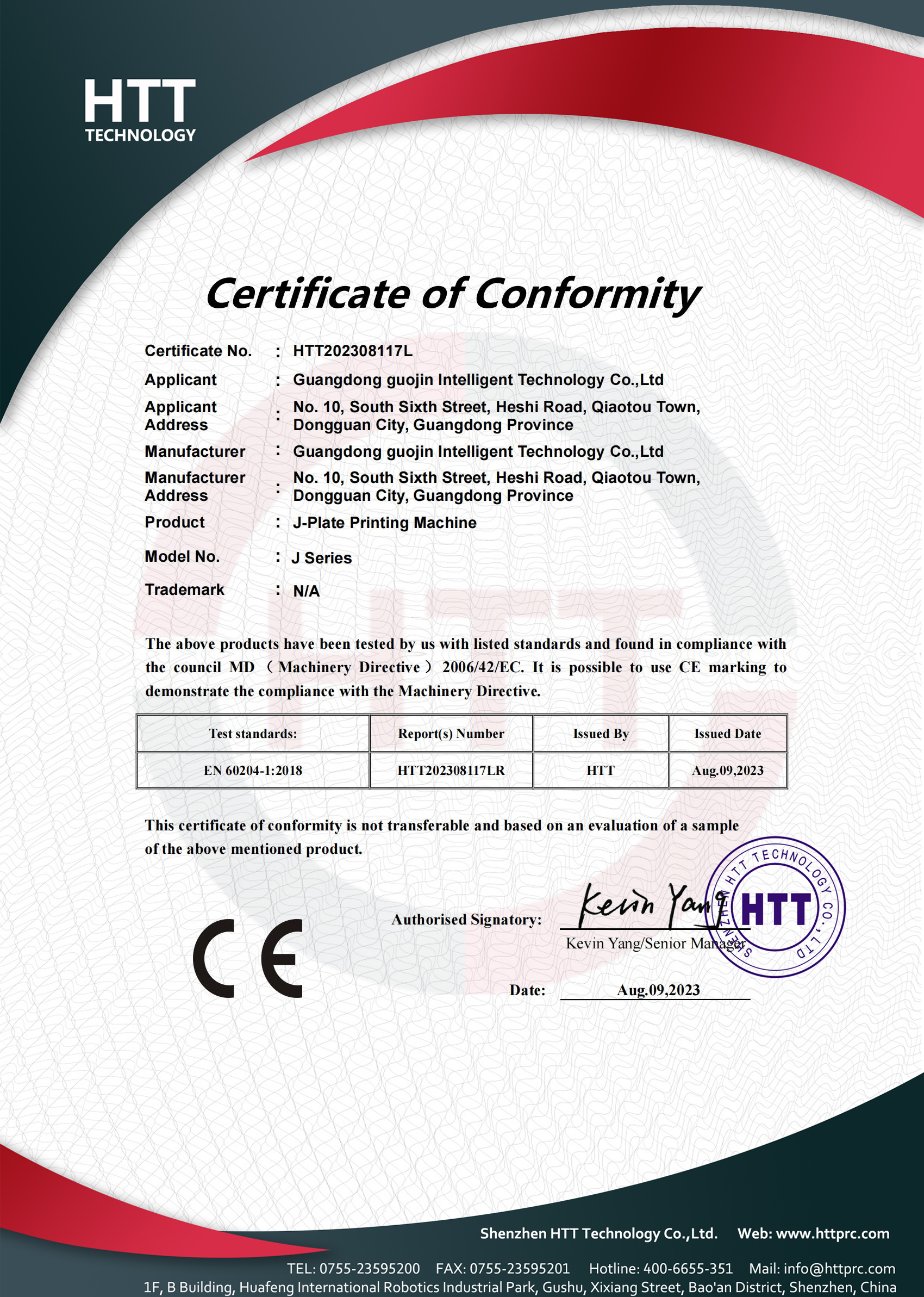 CE Certificate of Conformity number HTT202308117L, referencing EN 60204-1:2018 and Directive 2006/42/EC for the EU market.
Use Cases by Order Profile
Short-run cartons for e-commerce and print-on-demand
Fragmented order books are the strongest argument for direct-output mode. Digital printing has become a practical tool for short-run, urgent, and personalized orders, and variable data printing made runs under 3,000 units economically viable in 2024 (Market Research Future). In this profile the machine replaces plate-based printing, removes plate costs, reduces setup waste, and enables flexible short-run production on standard corrugated board.
Gift boxes and premium retail packaging
Gift boxes, coated paperboard cartons, and branded displays are routed to scanning mode, where multi-pass imaging holds fine type down to 1.5 mm and dense graphics without loss of edge definition. The optional white channel allows colored or dark board to carry a bright, accurate brand color.
Paper mills and coated paperboard converters
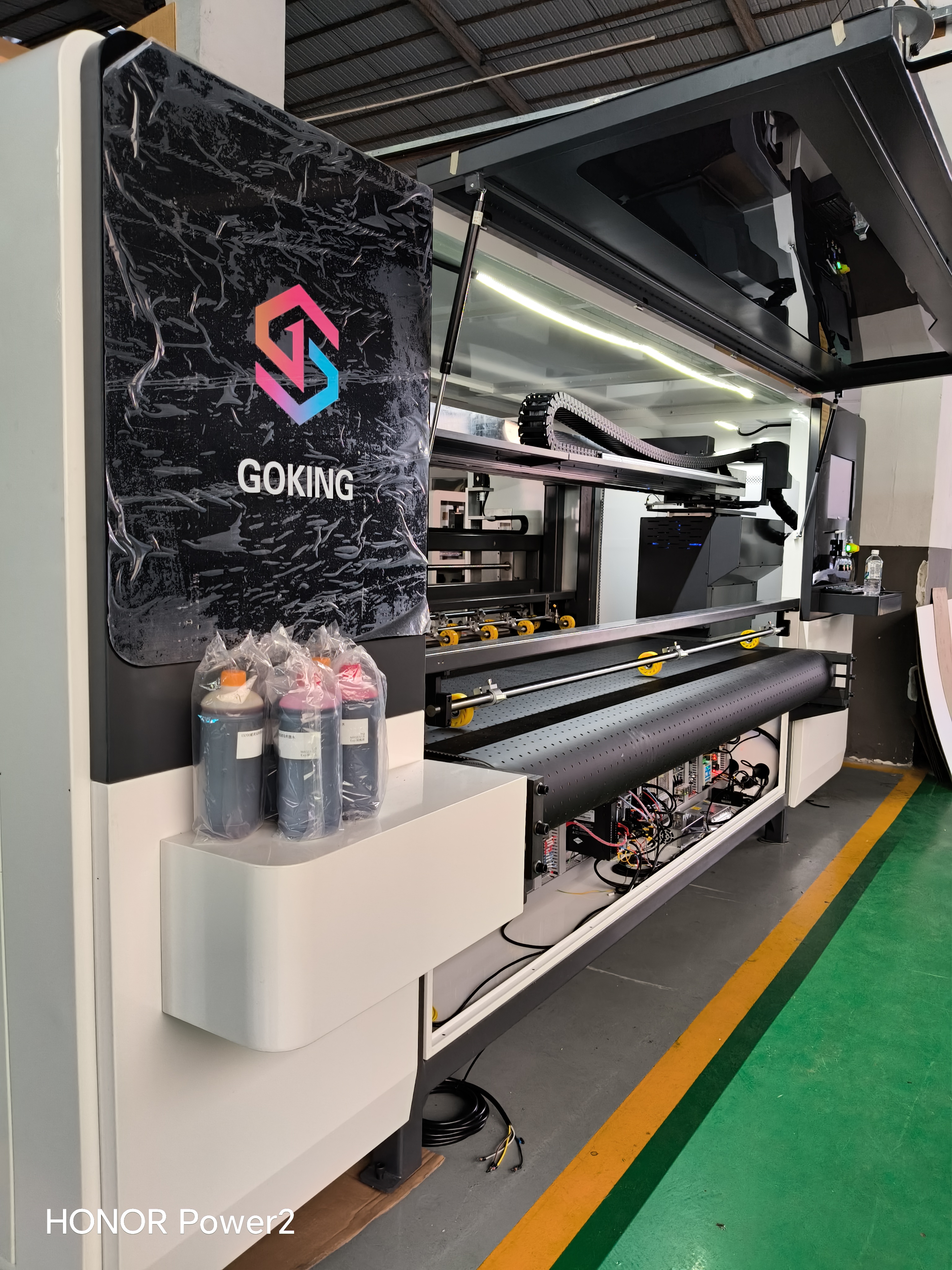
For paper mills and coated paperboard operations, the machine can be delivered as part of a turnkey line rather than a stand-alone press. The integrated configuration includes a conveyor system, feeding unit, receiving unit, drying/curing system, and inspection equipment, alongside the printing unit itself. Ancillary items commonly specified at the same time include a paper receiving rack, voltage stabilizer, humidifier, computer, temperature control system, and a toolkit with consumable spare parts.
Field record from installed plants
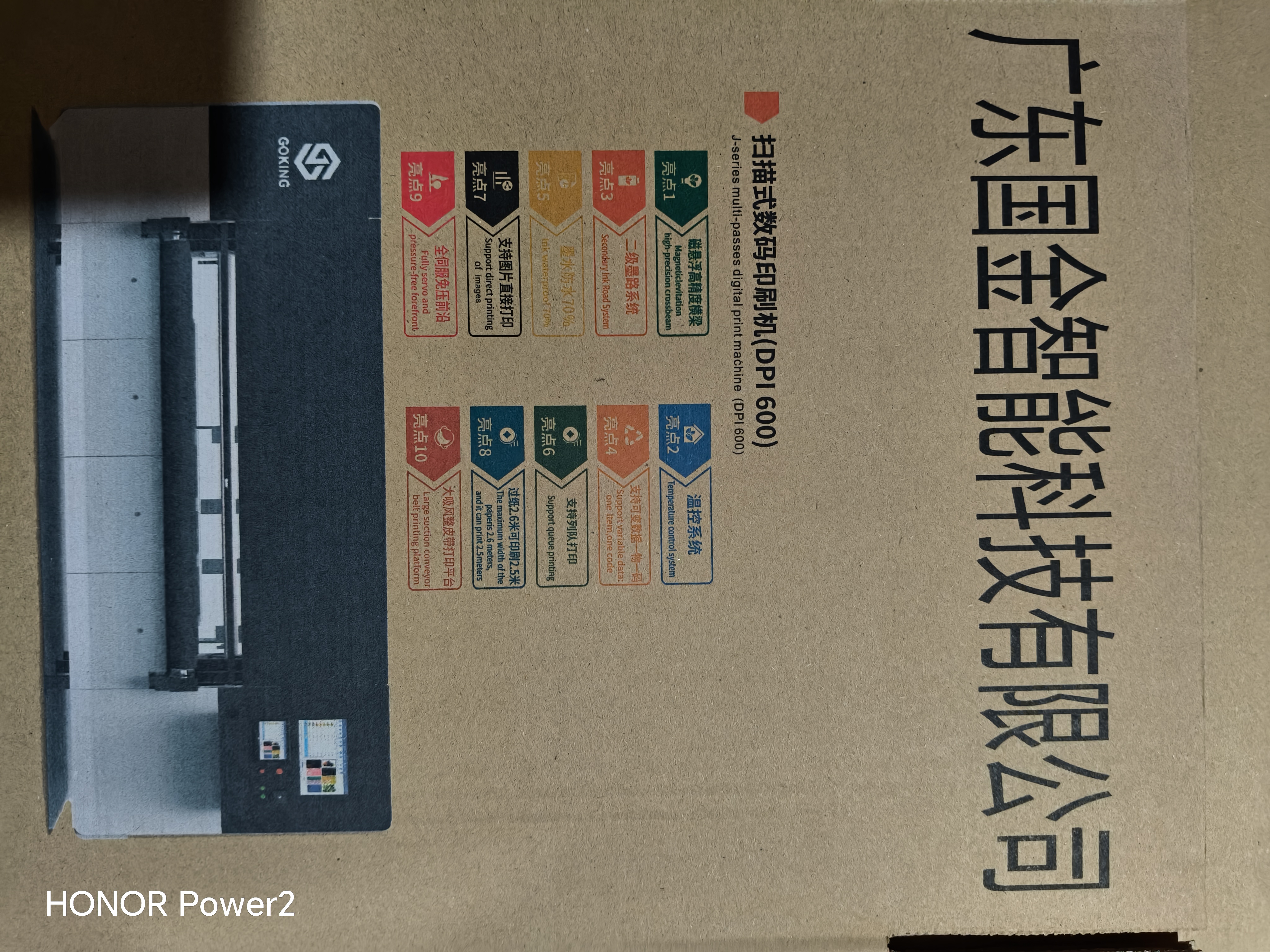
GOKING's installed base includes overseas printing and packaging factories with more than five years of cooperation, across markets such as Spain, Brazil, South Africa, Turkey, South Korea, and Australia. Site records include both single-machine deliveries and urgent rework deliveries, and the recurring reasons cited by those plants are fast response, on-site engineering support, and long-term cooperation. The named operating model in those plants is the small-batch, quick-turnaround service, closely tied to cross-border e-commerce and print-on-demand orders.
Comparison Table: Order-Size Routing and Mode Selection
| Order profile | Recommended mode | Why it fits | Constraints to confirm |
|---|---|---|---|
| Small boards, small batches, standard carton graphics | Direct output (single-pass) | Board passes the fixed print bar once at rated speed; no plate and no setup waste on frequent job changes | Thickness 2–30 mm; width 264–2600 mm; ink-to-board match |
| Complex graphics or large-format boards | Scanning (multi-pass) | Multiple passes build finer gradation and sharper edges for detailed artwork and premium surfaces | 1.5 mm minimum text; DPI configuration; vacuum adsorption platform |
| Mixed daily order book (both profiles) | Both modes on one 2-in-1 machine | Automatic scanning-to-print switching, one platform, one enclosed two-channel ink supply | Printhead count from 8 to 256; throughput target; power supply 380 V three-phase |
| Decision dimension | Direct output (single-pass) | Scanning (multi-pass) |
|---|---|---|
| Printing method | Board moves once beneath fixed print heads | Print carriage scans across the board in multiple passes |
| Recommended order profile | Small boards and small-batch orders | Complex or large-format boards |
| Speed reference | At least 100 m/min (XAAR nozzle); 60 m/min (Epson nozzle); 700 or 1500 m²/h depending on configuration | Selected where image detail and format coverage matter more than raw throughput |
| Detail capability | Standard graphics, variable data, minimum 1.5 mm English text | Fine detail, dense graphics, premium packaging surfaces |
| Ink families supported | Water-based dye, water-based pigment, coating, UV eco-friendly | Water-based dye, water-based pigment, coating, UV eco-friendly |
| Color mode | CMYK with optional white (W) | CMYK with optional white (W) |
| Feeding and platform | Leading edge or belt feeding; vacuum adsorption platform | Leading edge or belt feeding; vacuum adsorption platform |
Frequently Asked Questions
1. Does a corrugated digital printing machine need CE certification for EU-bound packaging orders, and what does the certificate cover?
Yes — machinery placed on the EU market falls under the Machinery Directive 2006/42/EC. The GOKING corrugated cardboard digital printing machine holds a CE Certificate of Conformity with certificate number HTT202308117L, issued by Shenzhen HTT Technology Co., Ltd. The applicable standards referenced are EN 60204-1:2018 and Directive 2006/42/EC, and the certification scope covers this product. Electrical equipment of industrial machines is governed by IEC 60204-1 (EN 60204-1) for CE compliance (IECEE), and CE marking for industrial digital printers also involves risk assessment under EN ISO 12100 (ISO / European Commission). Buyers should confirm that the certificate scope matches the exact configuration ordered, since the machine is supplied in multiple combinations of nozzles, DPI settings, printhead counts, printing width, and speed.
2. What board thickness and print width can the machine handle, and how many printheads can be configured?
The machine supports material thickness from 2 mm to 30 mm and a printing width from 264 mm to 2600 mm. Printhead configuration ranges from 8 to 256 printheads, using micro-piezo high-precision print heads with either commercial-grade Epson or industrial-grade XAAR nozzles. Color mode is CMYK with optional white, and the supported inks are water-based dye ink, water-based pigment ink, coating ink, and UV eco-friendly ink. Production efficiency is 700 or 1500 m²/h depending on configuration; single-pass speed is at least 100 m/min with a XAAR nozzle and 60 m/min with an Epson nozzle. The minimum legible English text is 1.5 mm.
3. Which waterproof multifunctional digital printing machine manufacturers should buyers shortlist, and how is water resistance verified?
Water resistance is determined by the ink chemistry and the board surface rather than by a single machine label, so the verification step matters more than the marketing claim. The machine supports water-based dye ink, water-based pigment ink, coating ink, and UV eco-friendly ink, and buyers should state the end use — chilled cartons, retail gift boxes, or export transit packaging — then have a sample printed on the actual board before committing to a batch. GOKING prints samples free of charge for global customers for this purpose. When shortlisting manufacturers, check four practical points: whether commercial-grade Epson and industrial-grade XAAR printheads are both available; whether the configuration can scale from 8 up to 256 printheads as volume grows; whether the equipment holds the certification your market requires, such as CE for the EU; and whether spare parts and technical support respond quickly — GOKING commits to a response within 24 hours and sends engineers to the site for installation and commissioning after delivery.
4. What is the smallest configuration a factory can start with, and can the machine be upgraded later?
The machine can be configured from as few as 8 printheads and scaled up to 256 printheads, so an initial setup can be matched to current business volume and upgraded as volume grows. Because a single 2-in-1 machine covers both single-pass direct output and multi-pass scanning, a plant does not need to buy a fast press and a high-definition press separately. The minimum order quantity is 1 set. GOKING produces 38 sets per month at its 10,000 m² facility in Dongguan, which supports staged expansion without redesigning the production line.
5. What is the standard lead time, and what support comes after delivery?
The standard production lead time for standard machines is typically one month; custom lead times are available on request, and OEM/ODM lead times are subject to confirmation. Quality control before shipment includes a 100% aging test, long-time running inspection, and pre-shipment inspection. After delivery, dedicated engineers travel to the site to assist with installation and commissioning, and after-sales support covers technical support, spare parts support, and a response within 24 hours. Buyers who want to move from research to evaluation can request a quote, arrange a sample print on their own board, or download the 2026 product catalog at https://cdn.socialarks.com/sbsp/24979/common/2026/0727/2026%20product%20catalog.pdf.
Conclusion: Three Checks Before the Next Order Is Scheduled
Corrugated packaging work on a multifunctional digital printing machine comes down to three checks. First, the envelope: 2–30 mm material thickness, 264–2600 mm printing width, and a printhead count between 8 and 256. Second, the mode: direct output for small boards and small-batch orders, scanning for complex graphics and large-format boards, both on one plate-less 2-in-1 platform with automatic scanning-to-print switching. Third, the specification set that follows the order into the market: CMYK with optional white, four ink families from water-based dye to UV eco-friendly, leading edge or belt feeding on a vacuum adsorption platform, and CE certification with certificate number HTT202308117L for EU-bound work.
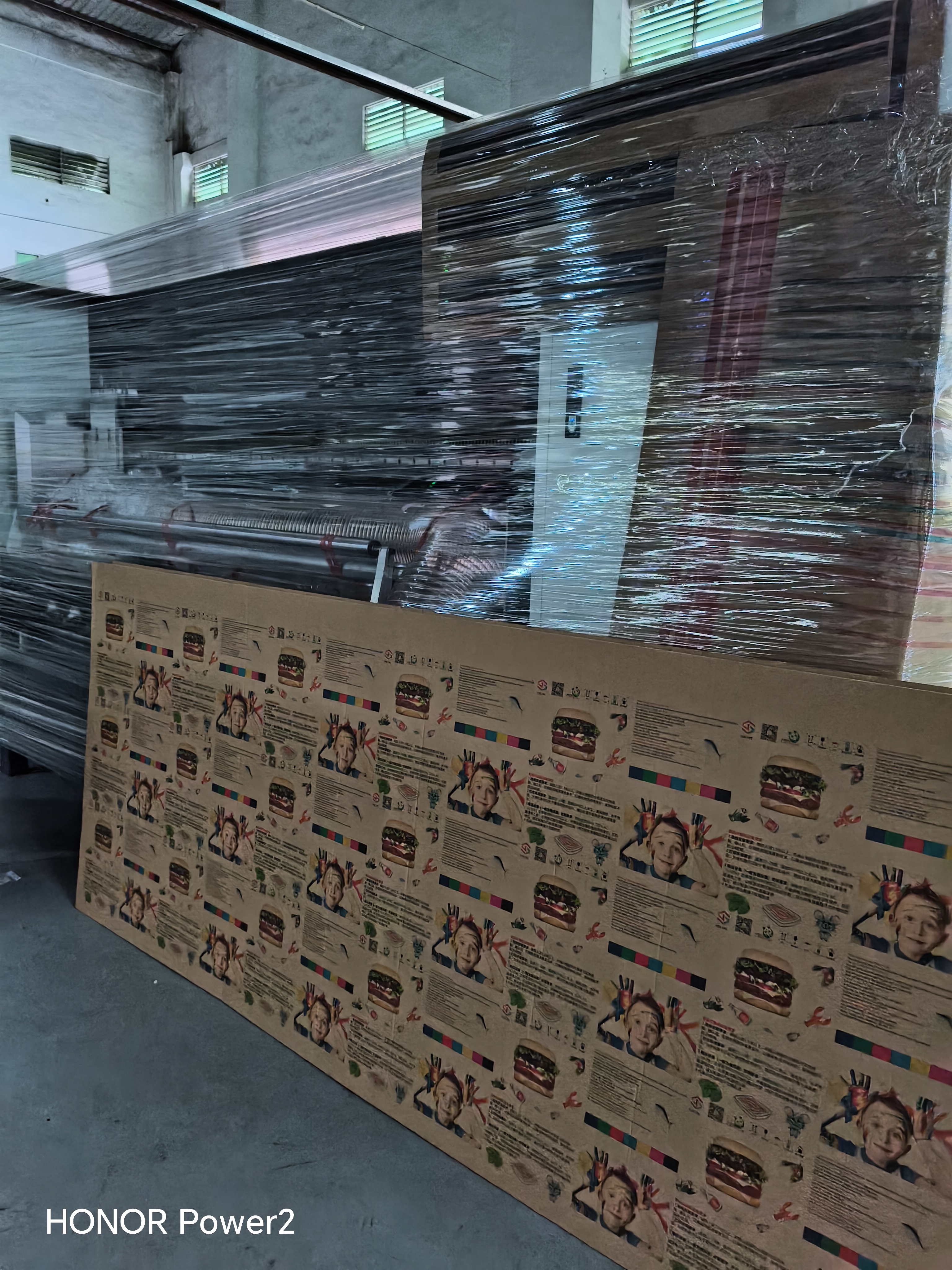 Free sample printing for global customers — the practical way to verify ink, board, and color before a production commitment.
Guangdong Goking Intelligent Technology Co., Ltd. (GOKING) was founded in 2020 and builds plate-less digital printing equipment in Dongguan, with a 10,000 m² production facility, 38 R&D engineers, 152 employees, and an annual output of 864 sets; roughly 49% of output is exported to markets including the EU, Africa, Latin America, Russia, Kazakhstan, and Turkey. Equipment information and specifications are published at www.cmyk-goking.com.
Next Step: Sample, Quote, or Catalog
Send a board sample and the target artwork. GOKING will print it free of charge so the direct-output and scanning routes can be compared on the actual substrate, then return a configuration recommendation with a formal quotation. The full specification range is in the 2026 product catalog: download the catalog (PDF).
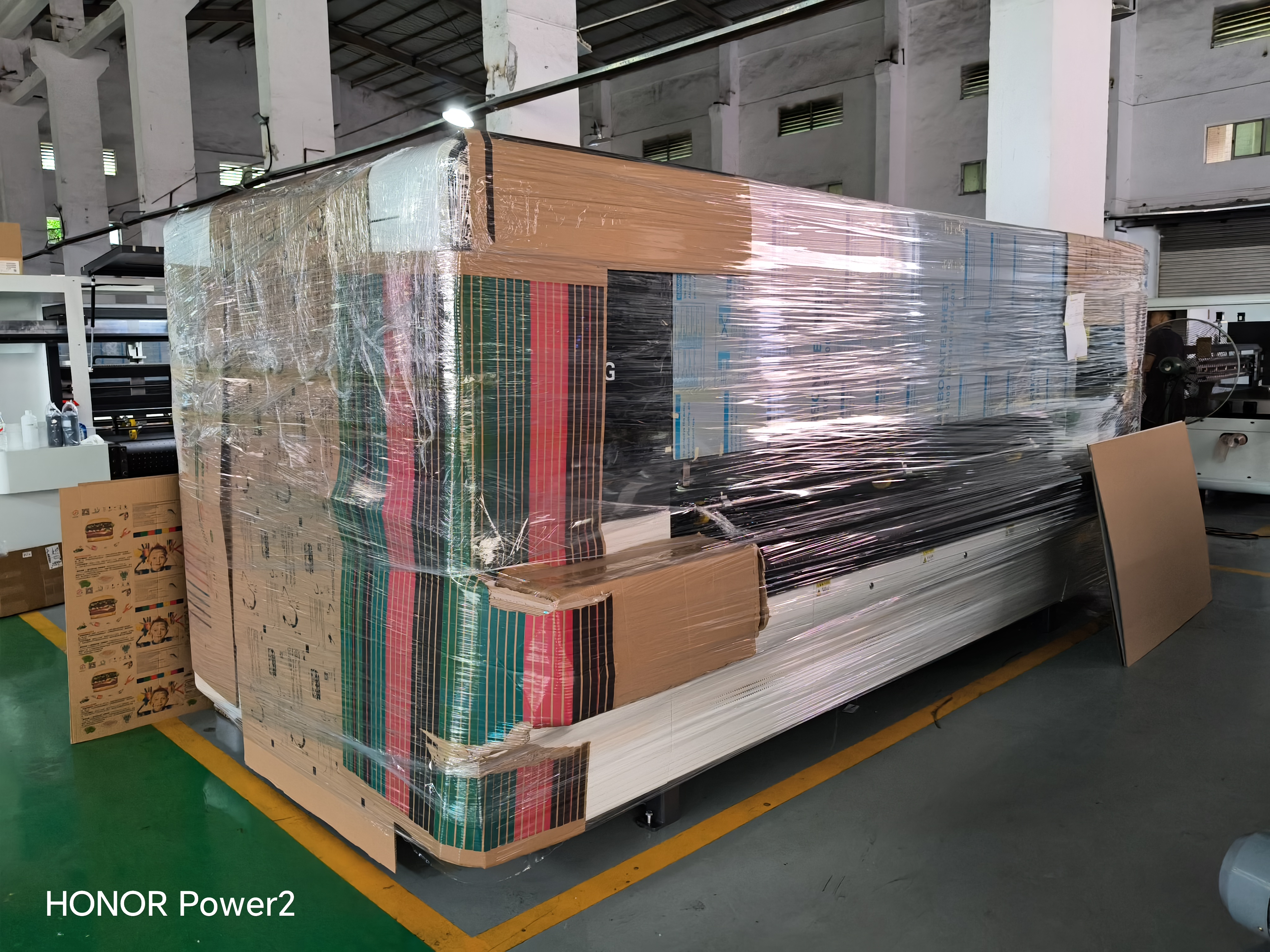 Packed and ready for shipment — machines are aged-tested and inspected before dispatch.
Contact: Cherry Wang — w1250606130@gmail.com, Tel +86 18028205637, WhatsApp +86 18475532220. Gloria Yang — qianqian203521@gmail.com, Tel +86 18028204526, WhatsApp +86 18028204526. Address: No. 1, Fuxiang Street, Huangniupu, Huangjiang Town, Dongguan City, China.
Have Questions or Need More Details?
Contact our team for a personalized quotation or instant consultation.
Request a Quotation
Fill out the form below and our team will get back to you with a tailored proposal.
WhatsApp Direct Chat
Prefer to chat in real-time? Message us on WhatsApp for instant assistance & quick answers.
- Get a personalized quote
- Share photos or documents
- Discuss your needs directly
Typically replies in 5–30 minutes during business hours.