
Leading-Edge vs Belt Feeding on a Multifunctional Digital Printing Machine
Two machines can carry the same printheads, the same ink set and the same DPI figures and still behave very differently on a packaging floor, because one picks up each sheet at its front edge while the other carries sheets on a belt. On the plate-less 2-in-1 multifunctional digital printing machine from Guangdong Goking Intelligent Technology Co., Ltd. (GOKING) — a Dongguan-based manufacturer established in 2020 whose main products are single-pass and multi-pass 2-in-1 digital printing machines plus 5-color integrated models with multiple DPI configurations and different nozzles — both feeding modes are available on the same platform: leading-edge feeding in semi-automatic or fully automatic form, and belt feeding. The print engine, the vacuum adsorption platform and the magnetic levitation high-precision crossbeam are shared. The feeding mode is what you configure around your board mix.
Direct answer: if your order book is dominated by large-format corrugated sheets and longer runs, evaluate leading-edge feeding first, usually in the fully automatic version. If small boards, small batches and frequent job changes dominate, evaluate belt feeding first. Both modes are listed on the same GOKING 2-in-1 platform, both work across a 2–30 mm material thickness range, and both print CMYK with optional white using water-based dye, water-based pigment, coating or UV eco-friendly inks — so the choice is a fit decision, not a capability upgrade.
Why Feeding Mode, Not Printhead Count, Decides Whether the Machine Fits
Buyers shortlist machines on the visible specification sheet: printhead count, DPI, print width, inks. Those numbers tell you what the machine can put on a board. They do not tell you how reliably it will take that board in, position it, and hand it to the print zone at production speed — and that is where the wrong configuration becomes expensive.
Three failures show up when the feeding mode does not match the work:
- Sheet pick at the edges of the thickness range. The platform accepts 2–30 mm material. Thin, flimsy board and thick, stiff board behave differently during pick-up and transfer, so the feeder has to be matched to the extremes of your range, not to its average.
- Job-change cost. Short runs only stay profitable when the changeover between jobs is short. A heavy-format feeder tuned for large sheets and a light-format feeder tuned for small boards respond differently to a job queue that changes every few hundred sheets.
- Format drift. Sheets that are correctly printed but mis-registered waste ink, board and finishing time. Multi-color registration starts at the feeder, which is why feeding choice and the vacuum adsorption platform have to be specified together.
The practical consequence: feeding mode should be one of the first three items on the specification, not the last. It is also the item most easily validated, because the machine prints free samples on your own board before you commit.
Industry Background: Why Configuration Questions Became Urgent
The pressure behind this decision is structural. Grand View Research valued the global digital printing market at USD 38.0 billion in 2023 and projects USD 57.0 billion by 2030, with inkjet holding the largest technology share at 48.4% of that market in 2023. MarketsandMarkets sizes the digital printing packaging segment at USD 30.2 billion in 2024, rising to USD 46.2 billion by 2029. Reports and Data puts the single-pass digital printing machine market at USD 3.2 billion in 2024, projected at USD 6.5 billion by 2034, and Market Research Future attributes roughly 41.6% of digital printing revenue share to Asia-Pacific in 2025.
Two of those trends push directly on feeding configuration. First, short-run economics have improved: Market Research Future notes that variable data printing made runs under 3,000 units economically viable in 2024, work that was previously cost-prohibitive. Short runs mean more job changes per shift, and more job changes shift the value of a feeder toward fast, repeatable set-up on small formats. Second, single-pass capacity keeps growing, which rewards plants that can keep large sheets flowing without stopping the press.
Supply has followed demand. China's digital printing machinery exports are supported by a concentrated industrial cluster in Guangdong province (EIN Presswire), which is where GOKING manufactures: a 10,000 ㎡ facility, 152 employees, an R&D team of 38 engineers, an annual output of 864 sets, and an export ratio of 49% across the EU, Africa, Latin America, Russia/Kazakhstan and Turkey. In a cluster this dense, the differentiator is rarely the printhead brand — it is how well the machine is configured to the buyer's actual board mix.
The Two Feeding Modes on the GOKING 2-in-1 Platform
The published specification lists the feeding mode as either leading edge feeding or belt feeding, with the feeding material described as leading edge feed or belt feed. The leading-edge type is optionally semi-automatic or fully automatic. Everything else — the micro-piezo high-precision print head, the vacuum adsorption platform, the magnetic levitation high-precision crossbeam, the 264 mm to 2600 mm print width and the 8 to 256 printhead range — is shared.
Leading-edge feeding: semi-automatic and fully automatic
A leading-edge feeder takes the sheet by its front edge and advances it into the transport path. On this platform the integrated configuration includes automatic lead-edge feeding, magnetic levitation hoisting, automatic scanning-to-print switching and direct output, with the feed unit listed alongside the receiving unit, drying/curing system and inspection equipment as part of the matched line.
The automation choice matters commercially. Semi-automatic leading-edge feeding keeps operator involvement in the loading cycle; fully automatic leading-edge feeding reduces that involvement and is the configuration to evaluate when the machine is expected to run continuously at high speed with fewer interruptions. Which of the two is right depends on labour structure and on how much of the shift the machine runs unattended — not on the print quality, which is identical.
Belt feeding: continuous transport held by vacuum
Belt feeding carries the sheet on a moving belt across the printing platform. On this machine the platform itself is a vacuum adsorption surface, so sheets are held down during transport and during printing. In packaging plants, belt transport is generally chosen when small boards and small batches dominate the queue, because a continuous belt flow handles frequent, repeated short jobs without re-tuning a front-edge pick cycle for every format change.
Belt feeding is also the mode that places the most demands on the vacuum platform, since hold-down has to remain consistent across the full 264 mm to 2600 mm print width for the smallest sheet you intend to run. That is why the smallest format you actually sell should be part of the sample request, not just the largest.
Where the two modes meet: 2 mm to 30 mm board
Material thickness on this platform is specified as 2–30 mm regardless of feeding mode. The thickness range is therefore not the dividing line between the two options — the dividing line is how the sheet is picked, aligned and held. Thin board at the low end of the range and heavy board at the high end both need to be proven on the actual feeder you order, which is exactly what free sample printing is for.
How the Feeding Choice Interacts With the Rest of the Machine
Feeding is not an isolated module. Four subsystems change how a feeding decision plays out in production.
1. The vacuum adsorption platform
The platform holds sheets by vacuum adsorption. For leading-edge feeding, that hold is what keeps a large sheet flat and registered as it passes under the crossbeam. For belt feeding, the same vacuum surface holds small sheets in position while the belt moves them through. In both cases, the practical question is the same: at the smallest and largest sheet in your mix, does the sheet stay where the feeder put it? A configuration that holds large sheets perfectly but lets small sheets shift will show up as registration errors on exactly the jobs you bought the machine for.
2. The magnetic levitation high-precision crossbeam
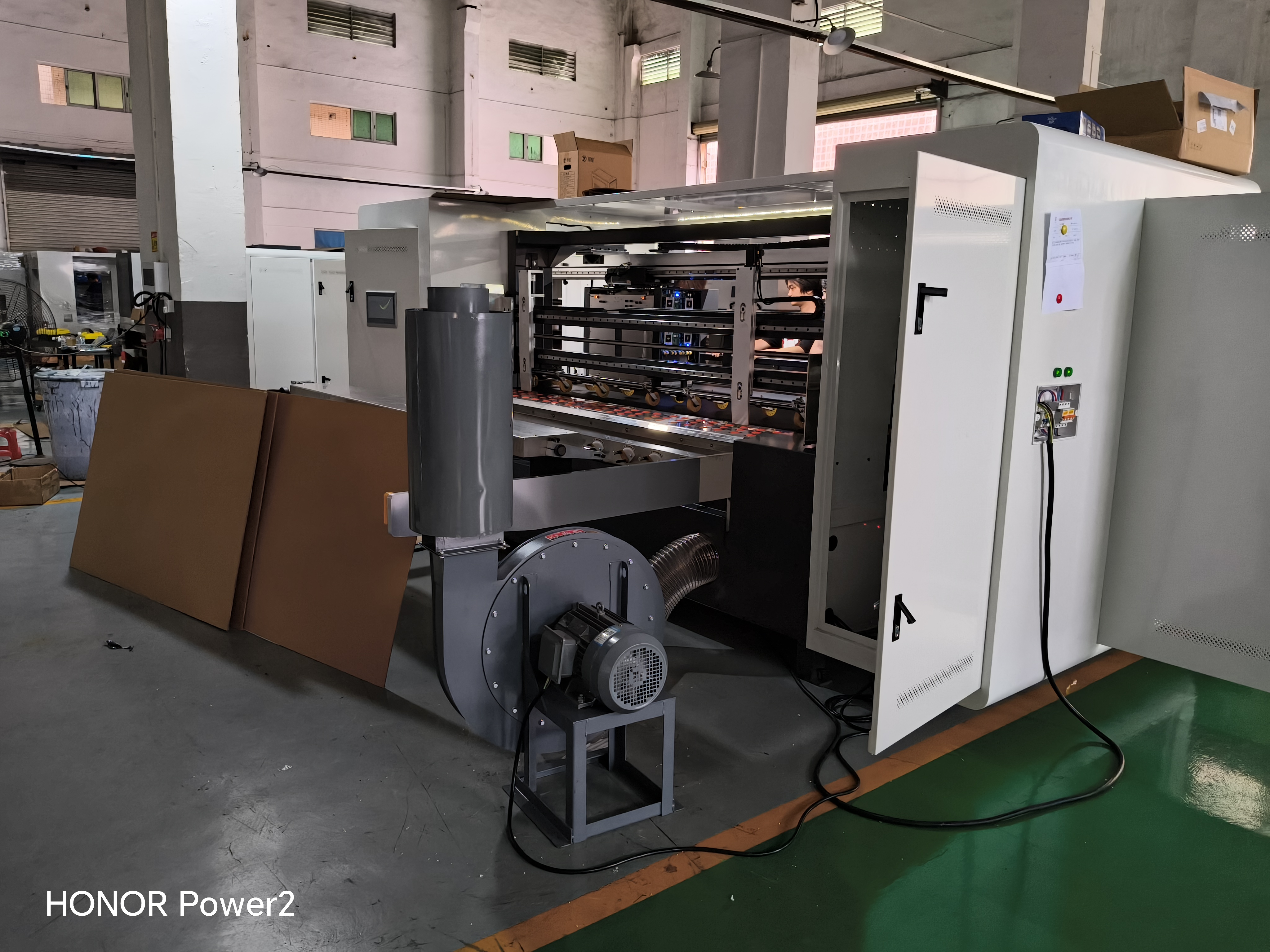
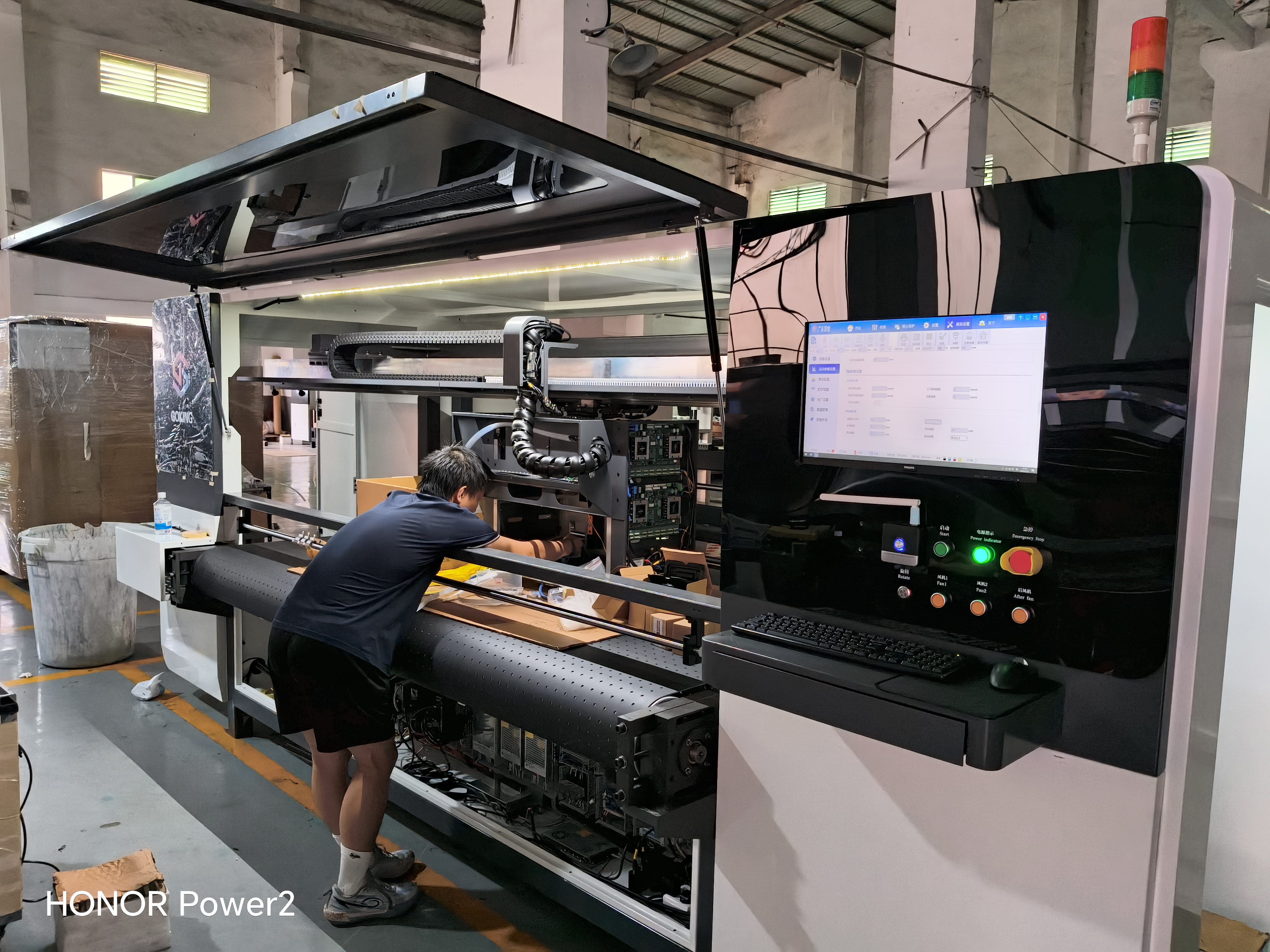
The machine uses a magnetic levitation high-precision crossbeam to carry the print head assembly. Precision at the crossbeam only pays off if the sheet arrives in the right position at the right moment, which is a feeder responsibility. This is the main reason a head-to-head comparison that ignores feeding is incomplete: the crossbeam sets the ceiling on registration accuracy, and the feeder decides how often you actually reach it.
3. Single-pass and multi-pass DPI configurations
The 2-in-1 architecture supports both single-pass and multi-pass printing on the same machine, at different DPI, with different printhead numbers. In single-pass configuration the machine uses a XAAR printhead; in multi-pass configuration it uses Epson or Xaar nozzles.
- Single-pass with XAAR (UK) industrial-grade printheads: models such as the Xaar 5601 and 1003 series use patented True Internal Circulation (TF Technology), circulating ink continuously behind the nozzles to reduce clogging and support stability during prolonged high-speed production. Single-pass printing speed with a XAAR nozzle is at least 100 m/min.
- Multi-pass with Epson (Japan) commercial-grade printheads: known for high precision and nuanced grayscale performance, suited to high-definition scanning work with rich color transitions. Single-pass printing speed with an Epson nozzle is 60 m/min.
The feeding implication is straightforward. Speed-led single-pass work rewards a feed system that never hesitates; detail-led multi-pass work rewards a feed system that places every sheet identically, pass after pass. Minimum digital text height is 1.5 mm in English, and the machine supports PDF, JPG, BMP and TIF files with RIP software that prints directly without converting pictures.
4. Efficiency configurations: 700 and 1500 m²/h
Production efficiency is offered in 700 or 1500 m²/h configurations. The efficiency figure is not independent of the feeding discussion: the higher configuration only delivers if sheets keep arriving at rate, so a plant specifying 1500 m²/h should expect the feeder and the automation level to be part of that conversation. Rated power is approximately 14 kW on a 380 V, 50/60 Hz three-phase supply, with Schneider electrical components and servo motor drives.
5. Ink sets on a CMYK + optional white platform
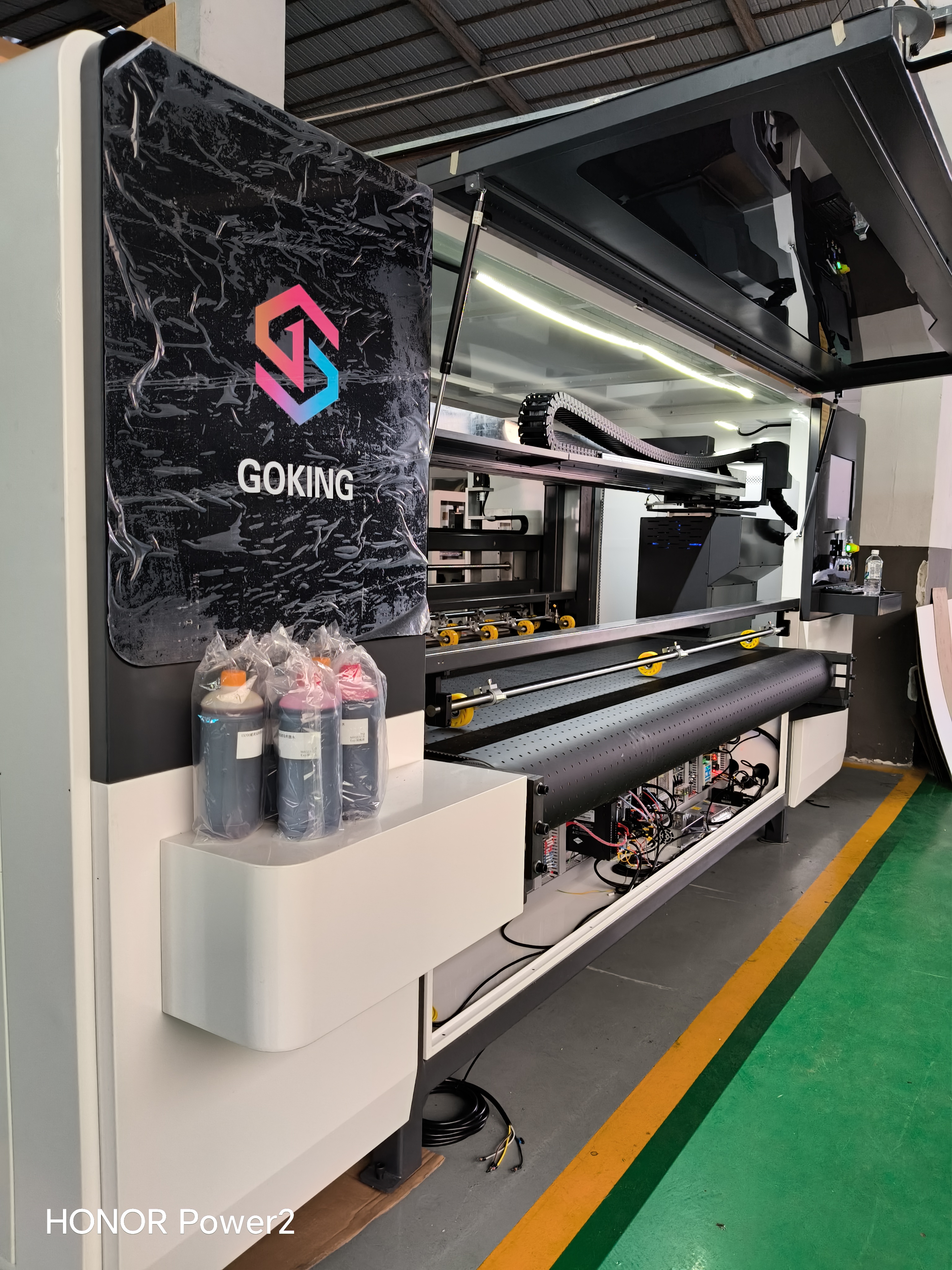
Color mode is CMYK with optional white. Ink options are water-based dye ink, water-based pigment ink, coating ink and UV eco-friendly ink. Two ink supplies feed a fully enclosed ink supply channel. Ink choice is tied to the substrate and to the finishing route — coated paperboard and kraft work differ in how they absorb and dry — and drying is specified after printing for carton, with other materials dependent on the material itself. The working environment is 15–32 °C at 70% humidity, and the machine measures 4260 × 2300 × 1900 mm at 2800 kg, built on a carbon steel frame with stainless steel conveying rollers and an aluminum alloy beam.
Step-by-Step: Choosing the Feeding Configuration for Your Board Mix
Step 1 — Write down the board mix, not the board average
List the smallest and largest sheet you actually sell, the thinnest and thickest board between 2 mm and 30 mm, and the run length per job. A plant that runs 90% large sheets and 10% small ones and a plant that runs the reverse should not buy the same feeder, even at identical annual volume.
Step 2 — Decide the automation level on the leading edge
If leading-edge feeding is the primary mode, choose between the optional semi-automatic and fully automatic versions based on how much of the shift the machine runs without operator intervention. This is a labour and throughput decision; print quality does not change.
Step 3 — Test the vacuum platform at both ends of your format range
Vacuum adsorption has to hold the smallest sheet as reliably as the largest. Request printing on your smallest format and your largest format rather than a convenient mid-size sample.
Step 4 — Match printing mode to the feeding mode
If the business is speed-led, single-pass with XAAR printheads at 100 m/min or more is the relevant configuration. If it is detail-led — fine text at 1.5 mm, high color gamut, gift-box grade work — multi-pass with Epson printheads at 60 m/min is the relevant configuration. Then check that the feeder can sustain that mode across a full shift.
Step 5 — Size the printheads and the width
Printhead count ranges from 8 to 256 and print width from 264 mm to 2600 mm. Starting at the low end and upgrading later is possible on this platform, so size the first configuration to the next 18 months of confirmed work rather than to an optimistic five-year plan.
Step 6 — Fix the ink set, the environment and the acceptance criteria
Confirm ink type against substrate and finishing, confirm the site can hold 15–32 °C at 70% humidity on a 380 V three-phase supply, and write the acceptance criteria into the order before production: which boards, which formats, which files, which registration tolerance.
Use Cases: Which Order Mix Pulls Which Way
Gift boxes and premium packaging
Gift box work is detail-led: high color gamut, small text, brand-critical color. That points to multi-pass printing at higher DPI, and to a feeding setup that places each small sheet identically. Belt feeding with vacuum hold-down is generally the first configuration to test when the gift box queue is dominated by small formats and short runs.
Corrugated and honeycomb cardboard packaging
GOKING manufactures digital printers for corrugated and honeycomb cardboard, and the machine is intended for the printing and packaging industry, paper mills and coated paperboard. When the queue is mostly large corrugated sheets in longer runs at 700 or 1500 m²/h, leading-edge feeding — fully automatic where continuous operation is planned — is the configuration to evaluate first.
Coated paper and kraft paper work
Coated paperboard and kraft absorb ink differently and often run in mixed batches on the same shift. Here the feeder decision usually follows the batch pattern: many small mixed batches favour belt feeding, fewer large batches favour leading-edge feeding. Ink selection (water-based dye, water-based pigment, coating or UV eco-friendly) should be settled in the same sample session.
Short-run and variable data production
With runs under 3,000 units now economically viable, the number of job changes per shift rises. Frequent changeover is the scenario where belt feeding earns its place, because the value being protected is set-up time rather than raw sheet throughput.
Comparison Table: Leading-Edge vs Belt Feeding at a Glance
| Decision factor | Leading-edge feeding | Belt feeding | What to confirm with GOKING |
|---|---|---|---|
| How the sheet is taken in | Sheet is picked at its front edge and advanced into the transport path; automatic lead-edge feeding is part of the integrated configuration | Sheet is carried on a moving belt and held on the vacuum adsorption platform | Which feeder variant is quoted for your line |
| Automation options | Semi-automatic or fully automatic (optional) | Automation level is not published as a selectable option in the standard specification | Automation level required for your intended unattended running time |
| Material thickness | 2–30 mm (platform specification) | 2–30 mm (platform specification) | Behaviour at the thinnest and thickest board you actually buy |
| Typical order profile | Large-format sheets, longer runs, fewer job changes | Small boards, small batches, frequent job changes | Where your real queue sits between those two profiles |
| Load on the vacuum platform | Hold-down keeps large sheets flat and registered through the crossbeam pass | Hold-down keeps small sheets positioned while the belt transports them | Sample printing on your smallest and largest sheet |
| Natural printing match | Single-pass with XAAR printheads for speed (at least 100 m/min) | Multi-pass with Epson or Xaar nozzles for detail (Epson single-pass speed 60 m/min) | Which mode earns the money in your order book |
| Ink and color | CMYK + optional white; water-based dye, water-based pigment, coating, UV eco-friendly | CMYK + optional white; water-based dye, water-based pigment, coating, UV eco-friendly | Ink set matched to your substrate and finishing |
The order-profile and printing-match rows are editorial guidance for shortlisting, not a published performance specification. The specification itself confirms both feeding modes, the 2–30 mm thickness range, the vacuum adsorption platform, the semi-automatic or fully automatic leading edge, and the printhead and speed figures quoted above.
Specification snapshot of the platform
| Parameter | Specified value |
|---|---|
| Feeding mode | Leading edge feeding / belt feeding |
| Type of leading edge | Optional semi-automatic, fully automatic |
| Material thickness | 2–30 mm |
| Printheads | 8 to 256, micro-piezo high precision |
| Print width | 264 mm to 2600 mm |
| Production efficiency | 700 / 1500 m²/h |
| Single-pass speed | 60 m/min with Epson nozzle; at least 100 m/min with XAAR nozzle |
| Color mode | CMYK (W) |
| Ink types | Water-based dye, water-based pigment, coating, UV eco-friendly |
| Platform | Vacuum adsorption |
| Crossbeam | Magnetic levitation high-precision crossbeam |
| Rated power | ≈14 kW, 380 V, 50/60 Hz, three-phase |
| Working environment | 15–32 °C, humidity 70% |
| Machine size / weight | 4260 × 2300 × 1900 mm / 2800 kg |
Frequently Asked Questions
What compliance checks should be completed before a multifunctional digital printing machine is shipped to the EU?
Industrial digital printers are assessed against EN ISO 12100 for risk assessment as part of CE marking, and the electrical equipment of industrial machines is governed by IEC 60204-1 (EN 60204-1). On this platform the electrical configuration is 380 V, 50/60 Hz, three-phase with a rated power of approximately 14 kW, so the supply at your site must match the declared configuration. Ask for the declaration of conformity and technical file that matches the exact configuration you order, including the feeding mode, printhead set and ink type, rather than a generic certificate.
Should I choose leading-edge feeding or belt feeding for boards between 2 mm and 30 mm?
Both feeding modes are available on the same platform and the specified material thickness range of 2–30 mm applies to the machine, not to one feeder. The decision therefore comes from the order mix rather than from thickness alone: leading-edge feeding — semi-automatic or fully automatic — suits large-format sheets in longer runs, while belt feeding suits small boards, small batches and frequent job changes. Because transfer behaviour depends on the specific board grade and sheet size, the reliable answer comes from free sample printing on your own material at both ends of your format range.
How do I shortlist Chinese multifunctional digital printing machine manufacturers?
Start with what can be checked: year established, factory size, headcount, annual output, engineering team size, export ratio and reference markets. GOKING, formally Guangdong Goking Intelligent Technology Co., Ltd., was established in 2020, operates a 10,000 ㎡ facility with 152 employees and 38 engineers, produces 864 sets annually, and exports 49% of output to the EU, Africa, Latin America, Russia/Kazakhstan and Turkey. China's digital printing machinery exports are supported by a concentrated industrial cluster in Guangdong province, so proximity and supply-chain depth are realistic selection criteria — but they should be verified through a factory audit, a specification review against your board mix, and paid or free sample printing before any order.
What drives the cost difference between configurations?
Configuration cost on this platform is driven by printhead count (8 to 256), print width (264 mm to 2600 mm), single-pass versus multi-pass architecture, the choice between semi-automatic and fully automatic leading edge, the optional white channel, and the 700 or 1500 m²/h efficiency level. Ink type — water-based dye, water-based pigment, coating or UV eco-friendly — also changes the running cost profile. The honest way to compare quotes is to fix the board mix and output target first, then compare configurations at the same specification, because a lower headline figure usually reflects fewer printheads or a narrower print width.
Can I validate the machine on my own board before purchasing, and what terms should I confirm?
Yes. GOKING prints samples for customers free of charge, which is the correct moment to test both feeding modes against your smallest and largest sheet. Before the order is released, confirm the purchasing terms and acceptance criteria in writing: board grades and thicknesses, sheet formats, print files and resolution, ink type, the feeding mode and automation level, the declared 380 V three-phase supply requirement, the 15–32 °C / 70% humidity working environment, delivery and installation scope, spare-parts and printhead support, and warranty coverage. To start a sample request, contact Cherry Wang at w1250606130@gmail.com, by phone on +86 18028205637, or via WhatsApp on +86 18475532220.
Conclusion: Configure the Feeder Around the Queue You Actually Run
Leading-edge feeding and belt feeding are not competing technologies on this machine — they are two ways of answering the same question: what does your order book look like on a normal Tuesday? Large sheets, long runs and continuous operation point toward leading-edge feeding, with the fully automatic version where operator intervention needs to stay low. Small boards, small batches and constant changeovers point toward belt feeding, where the vacuum adsorption platform does the holding and the queue keeps moving.
Whichever direction the decision goes, the supporting specification stays the same: 2–30 mm material thickness, print width from 264 mm to 2600 mm, 8 to 256 printheads, single-pass with XAAR or multi-pass with Epson and Xaar nozzles, CMYK with optional white, and a choice of water-based dye, water-based pigment, coating or UV eco-friendly inks on a 700 or 1500 m²/h platform. Settle the feeding mode first, and the rest of the configuration follows.
Next Step: Print Your Own Board Before You Decide
Send your board mix — smallest and largest sheet, thinnest and thickest board, typical run length — and GOKING will print free samples so you can compare leading-edge and belt feeding on your own material. Then confirm purchasing terms and acceptance criteria directly:
Guangdong Goking Intelligent Technology Co., Ltd.
Email: w1250606130@gmail.com | Tel: +86 18028205637 | WhatsApp: +86 18475532220
Website: www.cmyk-goking.com
Address: No. 1, Fuxiang Street, Huangniupu, Huangjiang Town, Dongguan City, China
Download the full specification and configuration list here: 2026 GOKING product catalog (PDF)
Have Questions or Need More Details?
Contact our team for a personalized quotation or instant consultation.
Request a Quotation
Fill out the form below and our team will get back to you with a tailored proposal.
WhatsApp Direct Chat
Prefer to chat in real-time? Message us on WhatsApp for instant assistance & quick answers.
- Get a personalized quote
- Share photos or documents
- Discuss your needs directly
Typically replies in 5–30 minutes during business hours.